Why Version Control Exists: The Pendrive Problem

I am a Front-end Developer with 7 years of experience, started from HTML, CSS and JavaScript then switched into any UI Development again switched into React Development. Now Looking for anything like in language and started digging into that slowly.
To understand why version control exists, let’s look at a simple real-world analogy(the pendrive workflow).
First, ask yourself a few questions:
Why do we need Git or version control?
Have you ever collaborated with teammates on the same project?
Did you face confusion, lost code, or merge issues during development?
If yes, then you’ve already faced the problems that version control was designed to solve.
Working Without Version Control (Small Projects)
When someone works on a "small project" with:
A single developer,
No complex dependencies
Things usually go smoothly. One developer can write the code and deliver it to the client.
But even in this case, some problems still exist:
Tracking when a feature was developed
Knowing what changes were made on a specific day
Reverting code written based on someone’s suggestion
If a bug appears and you want to remove(only the changes you made on a particular day), doing this manually is not easy for humans.
The Real Problem Starts with Team Development
Now imagine a real world scenario where multiple developers work on the same project.
Let’s say:
Developer A works on a feature
Copies the project to a pendrive and gives it to Developer B
Developer B makes changes and passes it to Developer C
Developer C makes changes and passes it to Developer D
Developer D again shares it back with Developer A
Now pause and think.
When Developer A starts working again:
How will they know what changes were made by Developer B or C or D?
What if one of their files was accidentally deleted?
Who will take responsibility?
How will anyone track which feature was added by whom?
This becomes confusing and chaotic very quickly.
Problems with the Pendrive Workflow
When multiple developers make changes like this:
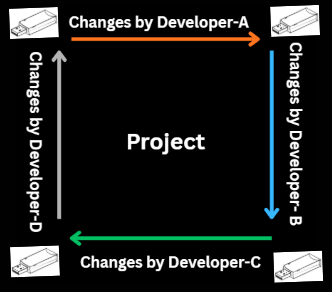
Several issues appear:
No way to track who wrote which code
No history of changes
No accountability for bugs
Collaboration becomes nearly impossible
Merging features becomes a nightmare
Development time increases significantly
At the end, combining everyone’s work is stressful and error-prone.
The “final_project” Problem
Another common issue developers faced was file versioning.
Projects were named like:
final_projectfinal_project_v2final_project_v3latest_finallatest_final_really_final
Developers kept old copies as backups in case something broke.
This:
Wasted storage space
Created confusion
Made it hard to know which version was correct
Why Version Control Became Necessary
After facing these problems for a long time, developers realized:
We don’t just need storage — we need a system to track, manage, and control changes.
This led to the introduction of Version Control Systems.
Today:
Version control saves time
Tracks changes automatically
Enables safe collaboration
Has become mandatory in modern software development
And among many version control systems available, tools like Git are now industry standards.
Today, version control saves time, tracks changes automatically, enables safe collaboration, and has become a mandatory part of modern software development.
Out of many version control systems, Git became the most popular because it solves real collaboration problems in a simple and powerful way.
Conclusion
The pendrive problem clearly shows why version control became a necessity in software development.
When teams relied on pendrives, emails, and folders like final, final_v2, or latest_final, collaboration was risky, changes were easily lost, and tracking work was almost impossible. As projects and teams grew, this way of working simply could not scale.
Version control systems solved these problems by providing:
Change history
Accountability
Safe collaboration
Easy rollback of code
Today, version control is not optional it is a core requirement for modern software development.
In the next blog, we’ll explore Git for Beginners: Basics and Essential Commands where you’ll learn how to use Git step by step with essential commands every developer should know.
If you found this explanation helpful, follow this publication for more beginner friendly tutorials on Git and software development.
I’d love to get your feedback or suggestions. Feel free to share your thoughts in the comments or you may Connect with me on LinkedIn.
Thank you for taking the time to read this.


